

The Global Theological Education Commission (GTEC) of the Confessional Evangelical Lutheran Conference (CELC) exists to promote theological friendships among our theological educators by connecting them and providing opportunities for discussion.
Dear Brother in Christ,
Revelation 7: The Great Multitude in White Robes
9 After this I looked, and there before me was a great multitude that no one could count, from every nation, tribe, people and language, standing before the throne and before the Lamb. They were wearing white robes and were holding palm branches in their hands. 10 And they cried out in a loud voice:
“Salvation belongs to our God,
who sits on the throne,
and to the Lamb.”
11 All the angels were standing around the throne and around the elders and the four living creatures. They fell down on their faces before the throne and worshiped God, 12 saying:
“Amen!
Praise and glory
and wisdom and thanks and honor
and power and strength
be to our God for ever and ever.
Amen!”
13 Then one of the elders asked me, “These in white robes—who are they, and where did they come from?”
14 I answered, “Sir, you know.”
And he said, “These are they who have come out of the great tribulation; they have washed their robes and made them white in the blood of the Lamb. 15 Therefore,
“they are before the throne of God
and serve him day and night in his temple;
and he who sits on the throne
will shelter them with his presence.
16 ‘Never again will they hunger;
never again will they thirst.
The sun will not beat down on them,’
nor any scorching heat.
17 For the Lamb at the center of the throne
will be their shepherd;
‘he will lead them to springs of living water.’
‘And God will wipe away every tear from their eyes.’”
Revelation 7:9–17 (NIV)
Dear Brother in faith and ministry,
Today we will ponder Psalm 23 and the second half of Revelation 7 side by side. Psalm 23 helps us understand Revelation 7. Revelation 7 helps us understand Psalm 23. Ponder with me for a few moments the similarities and the differences. As you continue your march towards the end of the academic school year (in most cases), remember that we are on a march to the end of this age. Be renewed by the promises of God given to us and assured to us in a Savior who has risen from the dead.
Psalm 23 and Revelation 7—I draw your attention to two similarities and three differences.
The first similarity is the use of the Shepherd image. In Psalm 23 we sing about the Lord, who is our Shepherd. He does everything for us. He nourishes our souls, he guides us in paths of righteousness, he protects us with his rod and his staff. In Revelation chapter 7, this Shepherd is also called the Lamb. He is on his throne. He takes care of his flock in heaven.
The second similarity is that the Shepherd is with his sheep. In Psalm 23 those are the central words: You are with me. Because he is with us, we find comfort in his rod and staff. He will protect us. In Revelation, the flock is gathered around Jesus, and he spreads his tent over them. He shelters them with his presence.
Before we go on to the differences, let’s pause to think about how important these facts are. You are a part of the church and you serve as a public minister in the church because you know and love this Good Shepherd, and because this Good Shepherd knows and loves you. You are in Christ and Christ is in you. Your Good Shepherd is with you.
Psalm 23 provides comfort at funerals because it proclaims a Good Shepherd who is with us every day of our lives, while we are dying, and after we have died—forever. Our Shepherd-King is with us always. His grace and his mercy chase after us all the days of our life, and we will dwell in the house of the Lord forever.
Revelation 7 records two visions for Christians living in the church militant. The first vision shows the saints fighting the fight of faith in this world—144,000 in 12 tribes; everyone in God’s army is accounted for. The second vision shows us a great crowd (from every nation on earth) wearing white robes and standing in front of the Lamb. They have come out of the great tribulation—their fighting is done. In Revelation 4 and 5 this countless crowd wasn’t mentioned. But here in Revelation 7 this great crowd is being highlighted. The elder asks John and John sends the questions back: Who are they and where did they come from?
The elder responds by saying that these are all the people who come out of the great tribulation of this sinful world; they are in heaven because the blood of the Lamb has made them perfect.
These are the believers for whom Jesus Christ was their Good Shepherd. Jesus was with them every day they were on earth. But now they are in heaven, and things are better.
While we are in this world, Jesus leads us in paths of righteousness. By his Word and by ministers of the Word, he teaches, rebukes, corrects, and trains his sheep. Their sinful flesh remains. Daily they fail. Daily they repent. Daily they find comfort in their merciful and forgiving God. But in Revelation 7, the Lamb who shepherds them leads his people to living water. They have life in God—life to the full, life as it was meant to be.
There is another difference: While we are in this world our Shepherd-King invites us to the banquet of his grace. Daily we read his Word. Daily he pours blessings upon his invited guests. While we are here, this happens in the presence of our enemies. Not only our sinful flesh which we already mentioned, but a hostile world, and the accuser of God’s people. We sing Psalm 23 and we live Psalm 23, in the presence of these enemies.
The scene in Revelation 7 is much different, much better. No thirst, no harming sun, no scorching heat, because God’s people are no longer in the wilderness, but in the promised land. There are no tears, because they have come out of the valley of tears. There are no enemies. None. They are gone forever. While we are in this world Jesus leads us through many dark valleys. But after he leads us through the valley of the shadow of death, the last enemy we will ever face—death—will be behind us forever.
There will be no need for us to fight against sin or to repent of our sins daily. We will be in the presence of God. We will see God face to face. Our Shepherd will spread his tabernacle over us. We will dwell with God, and he with us. That is Revelation 7’s promise to us, and it gives us great comfort, great hope, and great strength as we sing within the ranks of God’s earth-side army.
But when we arrive safely in the world to come—when we are heaven-side—we and everyone in this great multitude will see our risen Savior, the Good Shepherd who laid down his life and took it up again for us, face to face. This is not wishful thinking; it is certain hope.
And that is another difference. In Psalm 23 we say, “Surely, goodness and mercy will follow me all the days of my life, and I will dwell in the house of the Lord forever.” Surely. We say with confidence and in hope. In Revelation 7 the praises of all God’s saints and all his holy angels begin and end with “Amen” because all has been accomplished.
Psalm 23 is the song of the flock of Christ on pilgrimage. Keep singing it.
Revelation 7 presents Psalm 23 reality for Christ’s people when their pilgrimage has ended and eternity has begun. Amen.
Prayer: Lord Jesus Christ, Shepherd of the Church, in the waters of Baptism you have given us new life, and at your table you nourish us with the food of salvation. Lead us along safe paths through the darkness of this world, dispel the terrors of death, and bring us at last to your house, where you dwell with the Father and the Holy Spirit, one God, now and forever. Amen.
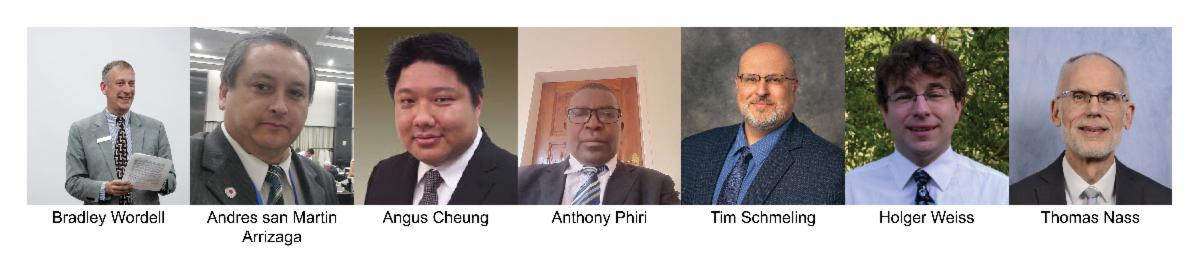
Brad Wordell serves as a professor of Old Testament and the director of continuing education at Wisconsin Lutheran Seminary. He also serves as a member of the WELS Commission on Inter-Church Relations (CICR) and as chairman of the Global Theological Education Commission (GTEC) of the Confessional Evangelical Lutheran Conference (CELC). Brad and his wife Andrea are blessed with five adult children and one grandchild.
Schooling for Life: Martin Luther Educator
This first essay was written to commemorate the 150th anniversary of Wisconsin Lutheran Seminary in 2013 and reprinted to celebrate the 500th anniversary of the Lutheran Reformation in 2017. In the essay Professor Arnold Koelpin invites us to rediscover Luther’s dual legacy as reformer and educator. Drawing extensively from Luther’s own words — his letters, table talk, sermons, and treatises — Koelpin paints a vivid and personal portrait of Luther as father, professor, and reformer of educational method, showing how his convictions about the gospel shaped everything from how he disciplined his children to how he treated struggling university students. Lutheran theological educators in the 21st-century will read this essay reflectively, not primarily as a historical survey but as a mirror, a chance to ask whether our own educational philosophy and practice have the same evangelical commitments. Luther was pedagogically creative, relationally warm, intellectually rigorous, and, above all, driven by the conviction that the goals of all education are to know Christ and serve our neighbor. An essay like this reminds us of our high calling as Lutheran theological educators: to grow in God’s grace ourselves and to form the minds and consciences of the next generation of gospel ministers.
Arnold Koelpin served as a WELS pastor and college professor for 45 years, 39 of which were spent teaching religion and history at Martin Luther College in New Ulm, Minnesota. The Lord called him home to heaven in November of 2017.
Lutheranism in the United States
A look at changes in US Lutheranism over the last 40 years.
The second article is this recent Forward in Christ article about the changing landscape of Lutheranism in America. In future GTEC newsletters we hope to explore the landscape of Lutheranism in other parts of the world.
Rev. Paul Prange is a husband and father of three who has served as a WELS pastor since 1988. He taught at Michigan Lutheran Seminary where he served as president for fifteen years. He was also Administrator for WELS Ministerial Education and chairman of the Joint Mission Council. He currently serves as the WELS Director of Worship and as Church Consultant.
If you have questions or comments about this newsletter, please email brad.wordell@wls.edu.
Scripture quotations taken from The Holy Bible, New International Version® NIV®. Copyright © 1973, 1978, 1984, 2011 by Biblica, Inc.® Used by permission. All rights reserved worldwide.
0 Comments